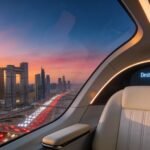







With exclusive deals signed with Joby Aviation and Skyports, Dubai is set to become the world’s first city where calling a flying taxi is as normal as booking an Uber.
For the better part of a century, the promise of “The Future” has included one specific, elusive milestone: the flying car. From 1950s science fiction to The Jetsons, the idea of soaring above gridlocked streets has been the ultimate symbol of technological mastery. Yet, for decades, it remained just that, a symbol.
In Dubai, however, the gap between science fiction and municipal policy is notoriously thin.
Come 2026, the skyline of Dubai, already a testament to human ambition, will host a new layer of infrastructure. It will not be made of asphalt or concrete, but of air corridors. The Roads and Transport Authority (RTA) has officially signed definitive agreements with Joby Aviation (for the aircraft) and Skyports Infrastructure (for the terminals), setting the stage for Dubai to become the first city in the world to launch a commercial, city-wide electric aerial taxi service.
This is not a pilot project. It is not a “proof of concept” confined to a remote desert test site. It is a procured, regulated, and capital-backed public transport network designed to integrate seamlessly with the everyday lives of the city’s residents. For the High-Net-Worth Individual (HNWI) living in Downtown or on the Palm Jumeirah, the morning commute is about to undergo a revolution that will make the luxury sedan obsolete.
The Anatomy of a ‘Vertiport’
To understand the scale of this disruption, one must look past the aircraft and focus on the ground. The genius of Dubai’s strategy lies in the “Vertiport.”
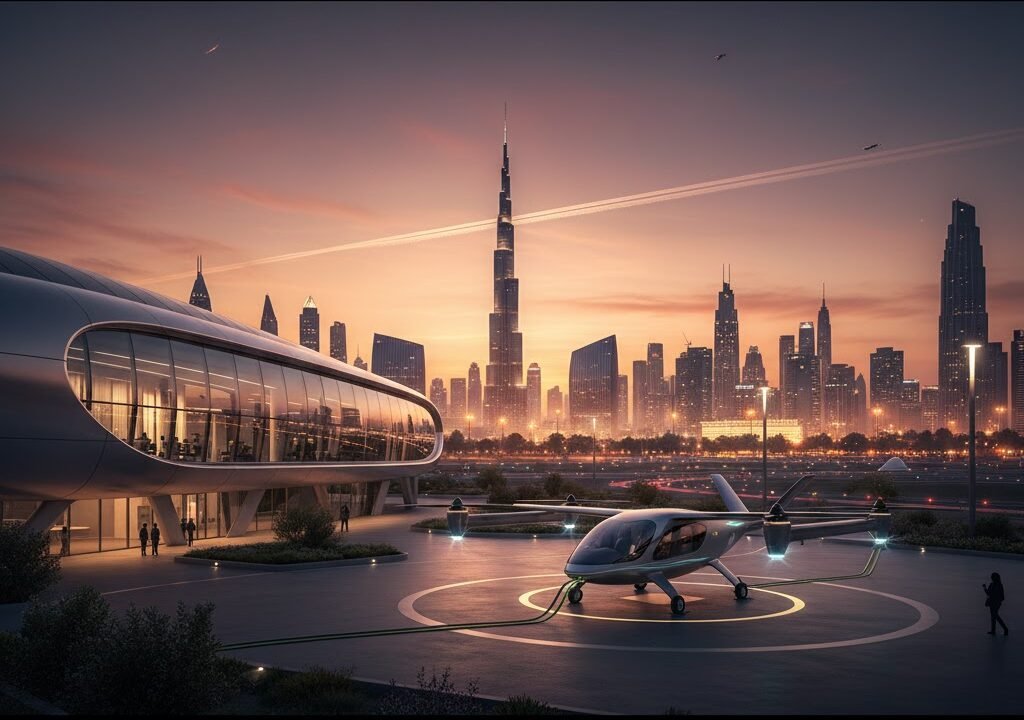
Unlike a traditional helipad, which is often a slab of concrete atop a skyscraper, a Vertiport is a sophisticated passenger terminal. Designed by Skyports Infrastructure, these hubs mirror the experience of a First-Class airport lounge, condensed into a hyper-efficient urban footprint.
The initial network will consist of four strategic nodes:
- Dubai International Airport (DXB): Integrating directly with commercial arrivals.
- Downtown Dubai: Steps away from the Burj Khalifa and Dubai Mall.
- Dubai Marina: Serving the high-density residential and leisure hub.
- Palm Jumeirah: Connecting the city’s most exclusive island villas.
The Passenger Experience: Imagine landing at DXB after a long-haul flight. Instead of navigating the highway traffic, you are escorted to a dedicated Vertiport terminal. You verify your biometric identity, step onto the tarmac, and board a silent, electric aircraft. Six minutes later, you are touching down on the Palm Jumeirah. The total journey time is reduced by 75%, transforming the geography of the city.


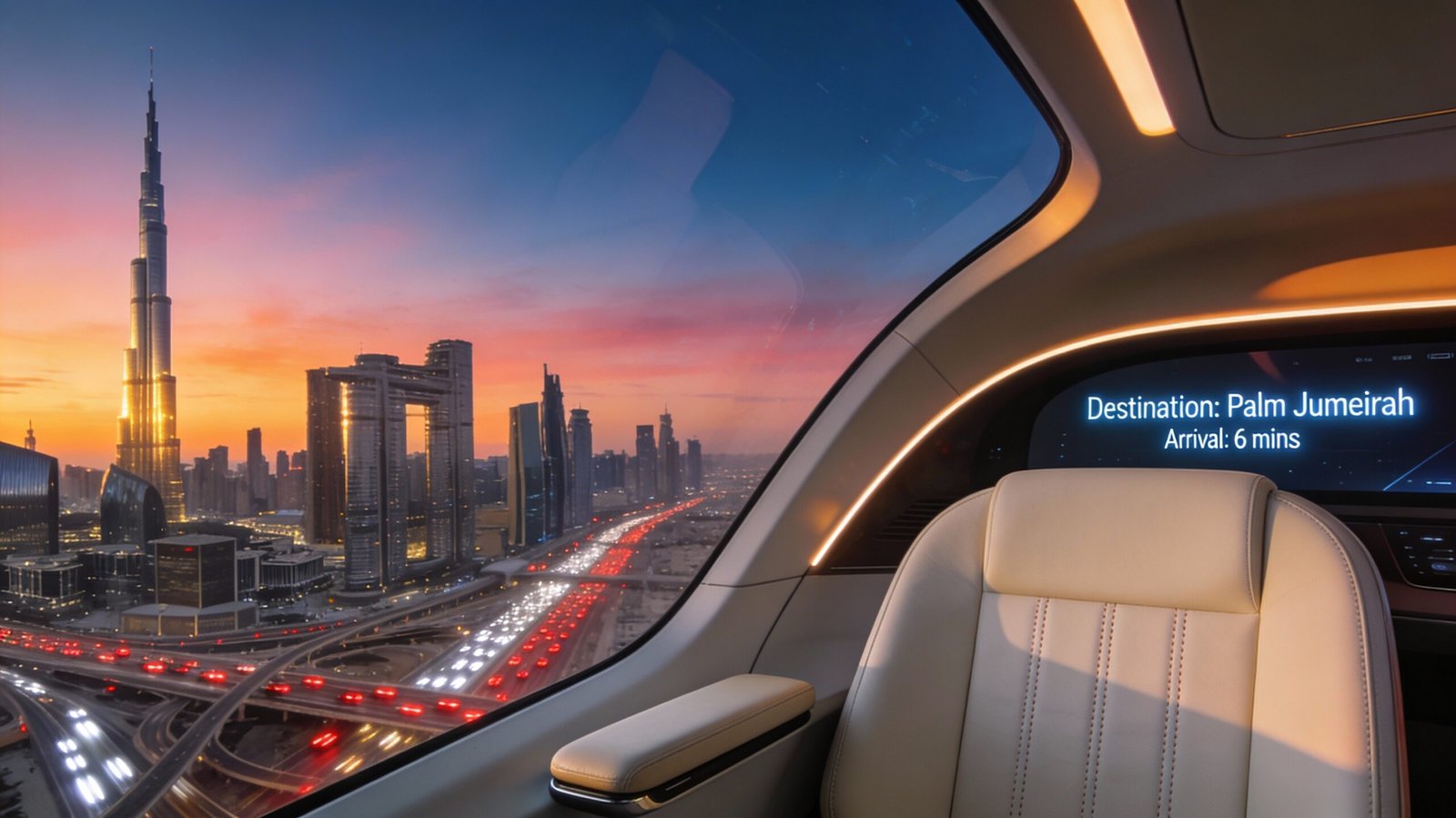
These terminals are designed for high throughput, utilizing advanced battery-swapping and rapid-charging technology to ensure aircraft can land, deplane, recharge, and take off again in minutes. It is the operational rhythm of a metro station, applied to aviation.
The Machine – Joby Aviation’s S4
The vehicle selected for this historic rollout is the Joby S4, widely regarded as the “Tesla of the Skies.”
For years, the skepticism surrounding flying taxis centered on three issues: Noise, Safety, and Cost. The Joby S4 addresses all three with engineering that feels closer to magic than mechanics.
- The Sound of Silence: Traditional helicopters are acoustic nightmares, generating 100+ decibels of chopping noise that reverberates off glass skyscrapers. The Joby S4 is an eVTOL (Electric Vertical Take-Off and Landing) aircraft. It utilizes six electric motors. During take-off, it is 100 times quieter than a helicopter. In flight, it is virtually silent, blending into the ambient hum of the city. This acoustic stealth is critical for gaining regulatory approval to fly low over residential areas.
- The Safety Redundancy: The aircraft is designed with no single point of failure. It can fly safely even if one or more motors fail. It is a piloted craft (initially), ensuring a human layer of judgment, backed by AI-assisted flight controls that manage stability in shifting wind conditions.
- The Speed: With a top speed of 320 km/h (200 mph), the aircraft turns distant suburbs into central districts. A commute from Dubai Marina to the airport, which can take 45–60 minutes during rush hour, becomes a 10-minute hop.
The Economic Ripple Effect
For the global investor, the launch of the Vertiport network is a market signal that extends far beyond transportation stocks. It serves as a leading indicator for Real Estate and Urban Planning.
The “Sky-Link” Premium: Just as proximity to a Metro station boosts property values in mass-market districts, proximity to a Vertiport will become the new gold standard for luxury real estate. Properties in Downtown and Palm Jumeirah with “Direct Vertiport Access” will command a significant premium. We are likely to see the emergence of “Sky-Lobbies” in future super-tall towers, dedicated floors where residents can board an eVTOL directly from their building, bypassing the street level entirely.
Business Efficiency: For the C-Suite executive, time is the only non-renewable resource. The ability to attend a breakfast meeting in Abu Dhabi, a lunch in Dubai Marina, and a board meeting in DIFC, all without spending hours in a car, creates a productivity dividend. Dubai effectively becomes a “15-minute city” on a macro scale. This connectivity reinforces Dubai’s value proposition as the ultimate global headquarters for conglomerates operating in the MEASA region.
Regulatory Sovereignty – Why Dubai First?
Why is this happening in Dubai and not New York, London, or Tokyo? The answer lies in Regulatory Sovereignty.
In Western jurisdictions, aviation innovation is often stifled by fragmented bureaucracy. The Federal Aviation Administration (FAA) in the US and EASA in Europe move cautiously, often taking decades to certify new asset classes.
The UAE’s General Civil Aviation Authority (GCAA), however, operates with a mandate to innovate. They have developed the world’s first national regulation for Vertiports. By creating a regulatory sandbox that prioritizes safety without sacrificing speed, the UAE has attracted the world’s best aerospace companies.
Joby Aviation didn’t choose Dubai just for the capital; they chose it for the clarity. The exclusive 6-year operational rights granted to Joby serve as a “Regulatory Moat,” protecting their early market share while ensuring the government has a single, accountable partner to perfect the safety protocols before opening the market further.
Sustainability & The Net Zero Goal
The Vertiport network is not a vanity project; it is a critical component of the UAE’s Net Zero 2050 strategy.
Transportation accounts for a significant portion of urban carbon emissions. By shifting high-frequency executive travel from gasoline-powered SUVs to zero-emission electric aircraft, Dubai is decarbonizing the luxury segment. The Vertiports themselves are designed to be energy-positive, utilizing solar skins and smart-grid integration to power the rapid chargers.
This aligns perfectly with the ethos of The Telegraph Middle East: showcasing “Future Living.” It proves that luxury and sustainability are not mutually exclusive; in fact, in the future, true luxury is sustainability. It is the ability to move freely without a carbon footprint.
The End of Traffic
As we approach 2026, the psychological geography of Dubai is about to change. Traffic, once an inevitable tax on urban living, will become optional for those who can afford to bypass it.
The launch of the flying taxi network is the physical manifestation of Dubai’s core philosophy: If you can imagine it, you can build it.
For the residents of this city, the future isn’t something to wait for; it is something you book on an app. As the first Joby S4 lifts off from the Palm Jumeirah Vertiport, silently banking toward the Burj Khalifa, it will carry more than just passengers; it will carry the message that the age of urban gravity has finally been conquered.