




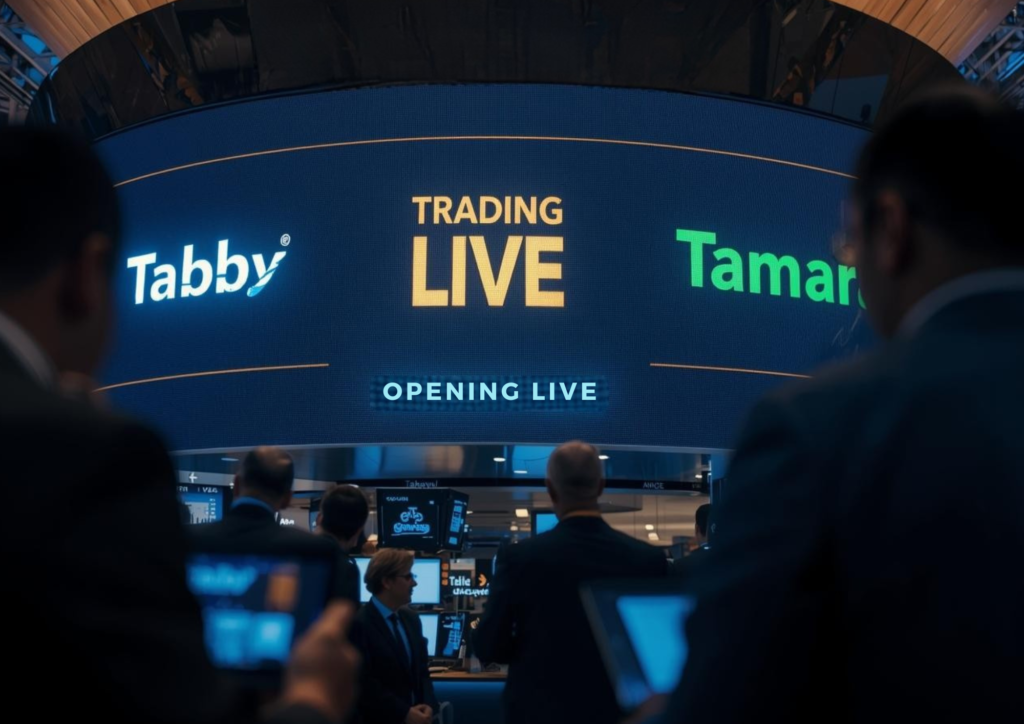

The venture capital era is ending, and the public market era has begun. With regional giants Tabby and Tamara finally filing for their long-awaited listings, 2026 is officially the “Year of the Exit.”
For the past five years, the Middle East’s startup ecosystem has been fueled by private capital. Venture Capitalists (VCs) poured billions into “Buy Now, Pay Later” (BNPL) platforms, creating the region’s first true “Unicorns” (startups valued at over $1 billion).
But unicorns cannot stay mythical forever. Eventually, they must become public horses.
In 2026, the stable doors have swung open. Following a record-breaking 2025 which saw preliminary filings, this year is poised to be the most significant in the history of regional capital markets. The UAE Fintech IPO 2026 pipeline is no longer theoretical; it is operational.
Leading the charge are the two titans of the industry: Tabby and Tamara.
The “Tabby” Debut: A Saudi Homecoming
While founded in Dubai, Tabby has chosen the Saudi Exchange (Tadawul) for its primary listing, a move anticipated since it moved its headquarters to Riyadh late last year.
The listing, widely expected in Q2 2026, follows a massive $160 million Series E round raised in early 2025. That capital injection was the final “war chest” needed to clean up the balance sheet before facing public scrutiny.
“Tabby’s IPO is the litmus test for the entire sector,” says Ibrahim Al-Jassim, a portfolio manager at a Riyadh-based asset management firm. “They aren’t just selling a growth story anymore; they are selling profitability. Investors in 2026 are demanding dividends, not just user growth. If Tabby trades well, it opens the floodgates for everyone else.”
Tamara: The $2.4 Billion Giant
Hot on its heels is Tamara, the Kingdom’s first homegrown fintech unicorn.
Having secured a landmark $2.4 billion debt facility from heavyweights like Goldman Sachs and Citi in late 2025, Tamara enters the 2026 public market with significant firepower.
Analysts predict that Tamara’s listing could be one of the largest tech IPOs in the region since Americana. The company’s shift from simple BNPL services to a broader financial services “Super App” (including payments and banking services) makes it an attractive proxy for the Saudi consumer economy.
Why 2026? The “Maturity” Factor
Why is the UAE Fintech IPO 2026 wave happening now?
- Interest Rate Stabilization: After the volatility of 2023-2024, global interest rates have stabilized, making equity markets attractive again for growth stocks.
- Regulatory Readiness: The UAE’s Securities and Commodities Authority (SCA) and Saudi’s CMA have spent the last two years refining the rules for tech listings, allowing for dual-class share structures that founders prefer.
- The “Talabat” Effect: The successful listing of Talabat on the Dubai Financial Market (DFM) in late 2024 proved that there is deep liquidity in local markets for tech stocks. Regional retail investors are hungry for brands they use every day.
The “Spillover” Candidates
It is not just the big two. The UAE Fintech IPO 2026 pipeline includes a second tier of mature startups watching closely.
- Huspy: The prop-tech mortgage platform is rumored to be exploring a dual listing (UAE and US) later this year.
- Lean Technologies: The open banking infrastructure provider could be the “dark horse” of 2026, providing the picks and shovels for the fintech boom.
Read More: Saudi Landbridge Project 2026: The $7 Billion Rail Revolution
Risks for Retail Investors
However, wealth managers urge caution. The transition from a private unicorn to a public company is brutal.
“Retail investors need to look at the ‘Bad Debt’ ratios,” warns Al-Jassim. “BNPL models are sensitive to economic downturns. In 2026, these companies are trading on high multiples. Any missed earnings report will be punished severely by the market, unlike in the private VC world where you can hide a bad quarter.”
For the Gulf’s economy, the UAE Fintech IPO 2026 class represents a graduation. The region is no longer just importing technology; it is capitalizing it, regulating it, and exporting it to the world.
When the bell rings at Tadawul later this year, it won’t just signal the start of trading for Tabby or Tamara. It will signal that the Middle East’s digital economy has officially grown up.