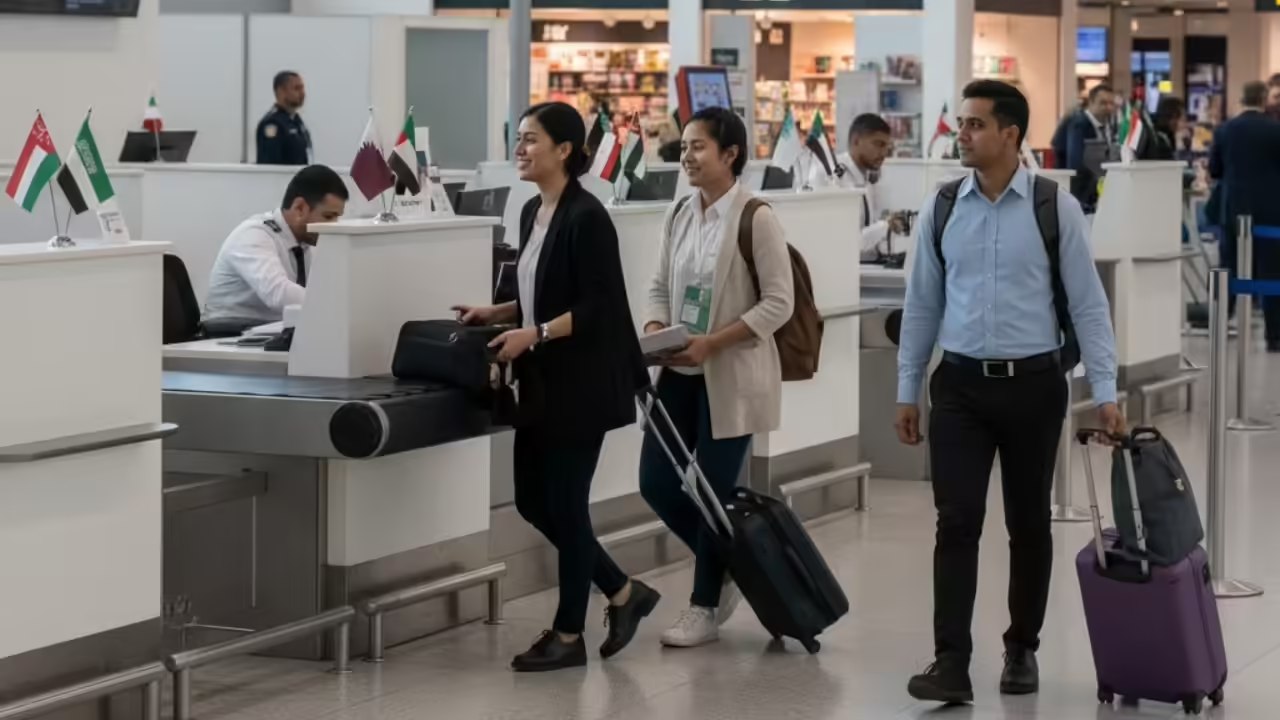








The borders have blurred. As of this week, the long-awaited ‘Grand Tours’ visa is operational, allowing tourists to visit all six Gulf nations on a single ticket. We analyze the cost, the rules, and the economic earthquake this will trigger.
For decades, the Gulf Cooperation Council (GCC) was a political and economic bloc, but for the average tourist, it was six distinct fortresses. Visiting Dubai, Riyadh, and Doha meant three separate visa applications, three separate fees, and three separate immigration queues.
In March 2026, the walls have come down.
Following final ratification by the Interior Ministers of all six member states late last year, the GCC Unified Tourist Visa 2026 application portal has officially gone live. Dubbed the “Grand Tours” visa, this policy shift is arguably the most significant tourism reform in the region’s history, effectively creating a “Gulf Schengen” zone for international travelers.
For the regional hospitality sector, it is not just a visa; it is a stimulus package worth billions.
The “Grand Tours” Visa: How It Works
The Ministry of Interior has released the full executive regulations for the new permit. Here is the breakdown for travelers and travel agents:
- The Concept: A single visa that grants entry to the UAE, Saudi Arabia, Qatar, Bahrain, Kuwait, and Oman.
- Validity: 30 Days (Single Entry) or 60 Days (Multi-Entry).
- The Cost: A unified fee of AED 500 ($136) for the 30-day pass. This is a massive saving compared to paying for six separate visas, which previously could total over AED 2,000.
- Eligibility: The visa is open to citizens of 85 countries initially, with plans to expand. Crucially, it is also available to GCC Residents (expats living in one member state) regardless of their profession, removing the old “profession-based” entry barriers.
“This is the friction-killer,” says Khalid Al-Mheiri, a tourism consultant in Dubai. “Previously, a Chinese tourist visiting Dubai might skip Saudi Arabia because the visa process was an extra hassle. Now, the friction is zero. The ‘Add-On’ trip to Al Ula or Salalah becomes automatic.”
The “Saudi-UAE” Axis
The biggest beneficiary of the GCC Unified Tourist Visa 2026 application launch is the cross-border corridor between the UAE and Saudi Arabia.
With Saudi Arabia’s Red Sea Project and NEOM now welcoming guests, the unified visa allows for “Twin Centre” holidays. Tour operators are already selling “Desert to Coast” packages: 3 days in Dubai, 3 days in Riyadh, and 2 days in Al Ula, all on one digital permit.


“We expect a 40% increase in cross-border tourism in Q2 2026,” notes a spokesperson for Seera Group, one of the region’s largest travel companies. “The logic is simple: If you are already flying 14 hours from Los Angeles to Dubai, why not see the rest of the neighborhood if the door is open?”
Security and Logistics
The implementation of the visa required a massive backend integration of the six nations’ immigration systems.
The new “Gulf Shield” security database allows immigration officers in Muscat to see if a traveler entered via Jeddah. This shared data infrastructure is designed to prevent overstayers.
- The “First Port” Rule: Similar to the Schengen system, travelers must apply for the visa through the country where they will arrive first.
- Biometrics: A single biometric scan at the first point of entry covers the traveler for the entire trip.
The Economic Impact: 128 Million Visitors?
The GCC’s collective target is ambitious: 128.7 million visitors by 2030. The unified visa is the primary engine to achieve this.
Economists predict a surge in “long-haul” tourism. Instead of the average 4-day stay, the unified visa is expected to push the average stay to 12-14 days, as tourists hop from the Louvre Abu Dhabi to the Souq Waqif in Doha.
“This changes the economics of hotels,” explains Al-Mheiri. “We are moving from a ‘Business Stopover’ market to a ‘Grand Tour’ market. You will see more multi-destination itineraries, similar to how Americans tour Europe, London, Paris, Rome. Now it will be Dubai, Doha, Riyadh.”
A Unified Destination
The launch of the GCC Unified Tourist Visa 2026 application signals a maturity in the region’s geopolitical mindset. It acknowledges that in the global tourism war, the GCC nations are stronger as a collective cluster than as competitors.
For the tourist in 2026, the Arabian Peninsula is no longer a puzzle of borders. It is a single, open canvas.