





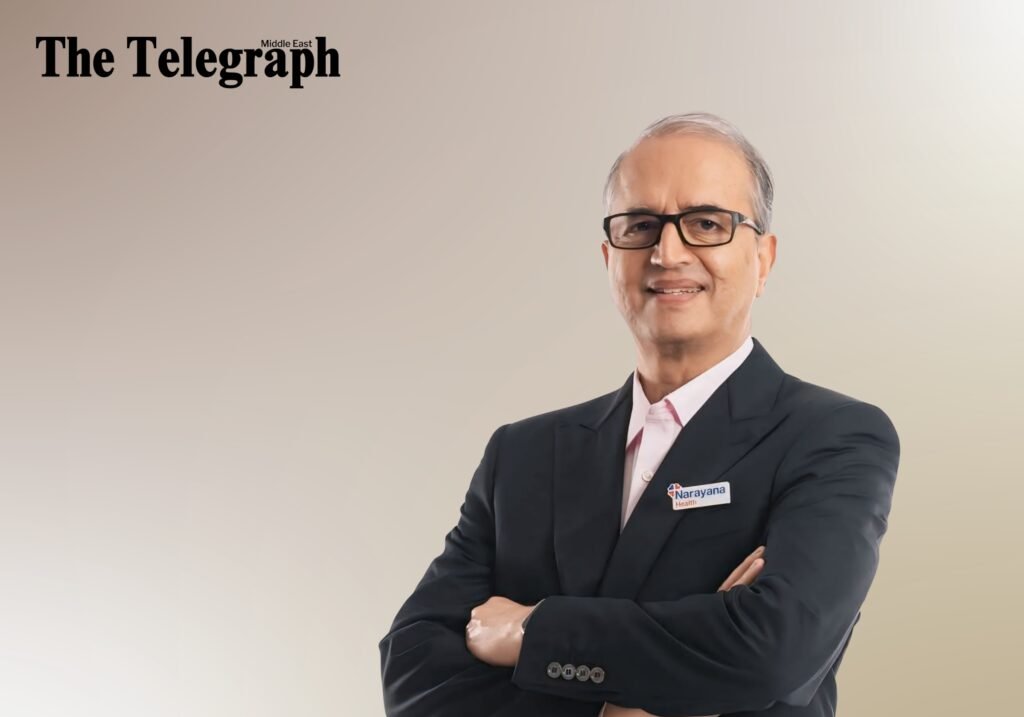

From the landmark acquisition of the UK’s Practice Plus Group to the “Udaan” medical education mandate, the Narayana Health founder is dismantling the traditional “Profit-per-Bed” model to create a $3,000 Crore “Sovereign Health Stack.”
In the high-stakes evolution of global healthcare, February 2026 has marked a definitive turning point for Dr. Devi Prasad Shetty. As the founder of Narayana Health (NH), he has moved beyond the operating theater to become a global infrastructure architect. While the world struggles with rising costs and medical backlogs, Dr. Shetty is executing a vision where India is the first nation to “dissociate healthcare from wealth.” For the Middle East market, where medical tourism and insurance integration are at a crossroads, this roadmap offers a blueprint for the future of sovereign wellness.
The London Bridge: Exporting the “Indian Efficiency” Model
The most explosive development in Dr. Shetty’s 2026 portfolio is the ₹2,200 crore ($265 million) acquisition of Practice Plus Group (PPG) in the United Kingdom. This isn’t just an expansion; it’s a historic reversal of history. Narayana Health is now the first Indian healthcare giant to provide large-scale surgical solutions to the British NHS.
By taking control of seven hospitals and multiple surgical centers across the UK, Dr. Shetty is testing his trademark “High-Volume, Low-Cost” methodology in a mature Western market. He believes that by streamlining day-care procedures and utilizing private-pay shifts, the “Indian model” can solve the global surgical crisis. This move has catapulted Narayana Health into India’s top three hospital chains by revenue, creating a unique “India-UK-Cayman” corridor for real-time medical innovation.+1
Project “Udaan”: Bridging the Skilled Manpower Gap
While many focus on building physical hospitals, Dr. Shetty’s “Udaan” initiative—highlighted this month in Bengaluru—is addressing the root cause of healthcare inequality: the shortage of trained specialists. As of February 2026, the program has supported over 2,000 medical and nursing students from economically modest backgrounds.+1
Dr. Shetty’s goal is to triple the number of doctors in training to fix the skewed doctor-to-population ratio, which in some rural Indian states remains as low as 1:2,700. By funding NEET scholars and MBBS students for as little as ₹50,400 per year, he is building a “Human Capital Moat” that will staff his projected 30,000-bed global network by 2030.+1
The “MANAV” Vision: AI as a Safety Net, Not a Replacement
At the India AI Impact Summit held this week, Dr. Shetty clarified his stance on the most debated topic in modern medicine: Artificial Intelligence. He argues that AI’s primary role is to handle the “boring work”—transcribing notes and predicting cardiac arrests hours in advance—allowing doctors to return to the “joy of caring.”+1
“AI will not make doctors redundant; it will make them safer for the patient,” he noted. By leveraging a fully digitalized medical record foundation, Narayana Health is now using smart software to provide a “second opinion” for every major treatment. His vision for the next decade includes a world where 90% of hospital beds are ICU-grade, while routine screenings move into community centers or the home through wearable integration.+1
The Insurance Gamble: “Aditi” and the Universal Health Stack
For Middle East investors and policymakers, the most significant “exclusive” is Dr. Shetty’s move into the insurance space. Under the brand Aditi, he is scaling a “Managed Care” model that mirrors his famous “Yeshasvini” success (where 1.7 million farmers paid pennies for coverage).
By 2026, he predicts that every Indian citizen will have adequate coverage to walk into a corporate hospital. He advocates for Health Savings Accounts as a zero-balance solution for the middle class, effectively creating a “Sovereign Health Stack.” As Dr. Shetty moves closer to his goal of a five-fold increase in capacity, he is proving that the future of medicine isn’t just about better drugs, but about an ethical, technologically-driven distribution of care that treats health as a human right, not a luxury.